
Complete Guide to Paint Protection Film
Everything you need to know about PPF — coverage, materials, maintenance, and value.
Quick Answer
Paint protection film (PPF) is a transparent protective film applied over a vehicle’s painted surfaces to help reduce damage from rock chips, road debris, minor abrasions, and everyday environmental exposure. It can protect targeted high-impact areas or extend across the entire vehicle, depending on the owner’s needs. Coverage may range from Bumper Protection and Partial Front packages to Full Front, Track Package, or Full Vehicle protection. The right coverage depends on how the vehicle is driven, where it is used, and the owner’s preservation goals. Professional installation also helps ensure the film is properly fitted to the vehicle’s body panels.
What Is Paint Protection Film?
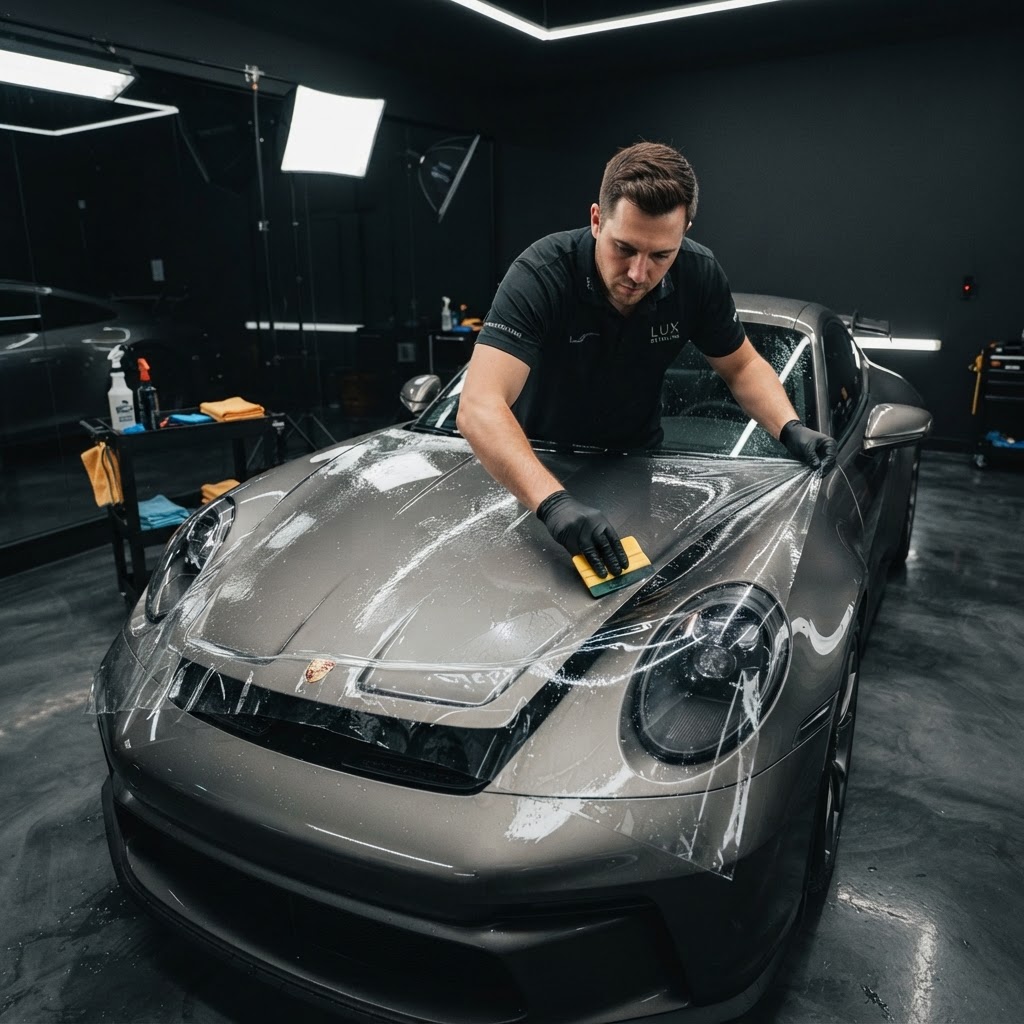
Paint Protection Film (PPF) is a transparent, self-healing thermoplastic urethane film applied to the painted surfaces of a vehicle. Its primary role is to act as a sacrificial protective layer between the vehicle's paint and the everyday hazards it encounters on the road. Unlike a coating that bonds to the surface, PPF is a physical barrier — a durable, optically clear film that conforms to the contours of the body panels it covers. Explore our PPF services to see how coverage can be tailored to your vehicle.
What Does PPF Help Protect Against?
PPF is designed to help reduce the visible impact of common road and environmental exposure. The types of hazards it can help mitigate include:
- Rock chips from loose gravel and road debris
- Minor abrasions from incidental contact
- Bug residue and acidic environmental deposits
- Light scuffs and surface marks from everyday use
- General environmental exposure such as road grime and airborne particles
It is important to understand that PPF helps reduce the risk of cosmetic damage — it does not make paint damage impossible. Severe impacts, sharp objects, or concentrated force can still affect the film and the surfaces beneath it. PPF is best understood as a measured layer of protection that helps preserve the cosmetic condition of the painted surfaces it covers.
Understanding PPF Coverage Options
PPF coverage is not a single, uniform application. At ArtDeShine Studios, coverage is structured in a progression that allows owners to match protection to their vehicle, their driving environment, and their preservation goals. The standard coverage options are:
- Bumper Protection — focused coverage on the front bumper, one of the most commonly impacted areas.
- Partial Front — extends coverage from the bumper across the hood and fenders to a defined boundary line.
- Full Front — covers the full front-end painted surfaces, including the complete hood, fenders, bumper, and mirrors.
- Track Package — adds high-impact zone coverage suited to performance and enthusiast driving conditions.
- Full Vehicle — the most comprehensive option, covering painted surfaces across the entire vehicle.
For a deeper look at how two of these options compare, see our coverage comparison. The right coverage depends on how the vehicle is used, the level of road exposure it sees, the owner's preservation goals, and budget. There is no single correct answer — the goal is to align protection with real-world use.
Choosing Coverage Based on How You Drive
Driving habits are one of the most practical factors in selecting PPF coverage. A vehicle used for daily commuting on highways will typically encounter more loose debris and higher-speed impacts than a weekend enthusiast vehicle stored between drives. Owners who regularly travel on highways or rougher road surfaces may find broader front-end coverage — such as Full Front or Track Package — more aligned with their exposure. Owners whose vehicles see lighter, occasional use may find that Partial Front or Bumper Protection addresses their primary concern without extending coverage further than necessary.
Performance and track-oriented use introduces a different consideration. In those environments, high-impact zones beyond the standard front-end areas can benefit from added protection, which is where a Track Package can become relevant. For owners prioritizing broader cosmetic preservation across the entire vehicle, Full Vehicle coverage offers the most comprehensive approach. The key is to match coverage to actual exposure rather than assuming more is always better.
Why Installation Quality Matters
The performance and appearance of PPF depend heavily on how it is installed. Even a high-quality film can underperform if the installation process is rushed or the environment is not properly controlled. Professional installation typically involves careful panel preparation, accurate film placement, and precise edge alignment so the film conforms cleanly to the vehicle's body lines.
A clean, controlled installation environment helps reduce the risk of contamination being trapped beneath the film. Vehicle-specific fitting — patterning the film to the actual contours of the model rather than relying on generic cuts — helps ensure the coverage follows the intended surfaces without unnecessary seams or gaps. Installation quality is a meaningful factor in how the film looks and how it performs over time, which is why it is worth treating the installation itself as part of the product, not just the film.
PPF and Long-Term Vehicle Preservation
PPF can be part of a broader cosmetic preservation strategy for owners who want to maintain the condition of their vehicle's painted surfaces over time. By helping reduce the accumulation of rock chips, minor abrasions, and environmental deposits on the covered areas, PPF can contribute to keeping the original paint in better cosmetic condition than it might otherwise maintain.
It is reasonable to think of PPF as one component of a preservation approach that may also include careful washing, protective coatings, and considered storage. It is not a guarantee of resale value, a guarantee of paint condition, or a product with a universally fixed lifespan. How the film performs over time depends on the specific film, the environment, how the vehicle is maintained, and how it is used. Owners looking to extend the serviceable life of their film should follow appropriate care practices — our washing guide covers the basics.
How to Choose the Right PPF Package
Choosing the right PPF package comes down to a practical assessment of a few key factors:
- Driving habits — how often the vehicle is driven and on what kinds of roads
- Road conditions — highway, urban, rural, or performance environments
- Vehicle type — the shape, size, and painted surface area of the vehicle
- Areas most exposed to debris — typically the front-end surfaces, but potentially broader for certain use
- Preservation goals — whether the priority is targeted protection or comprehensive coverage
- Desired coverage level — how much of the vehicle the owner wants protected
- Budget — balancing coverage scope with available investment
There is no universal correct package — the right choice is the one that aligns protection with how the vehicle is actually used and what the owner wants to preserve. Owners who are unsure about which coverage level fits their situation can discuss their vehicle and driving habits with an ArtDeShine specialist, who can help translate those details into an appropriate coverage recommendation.